
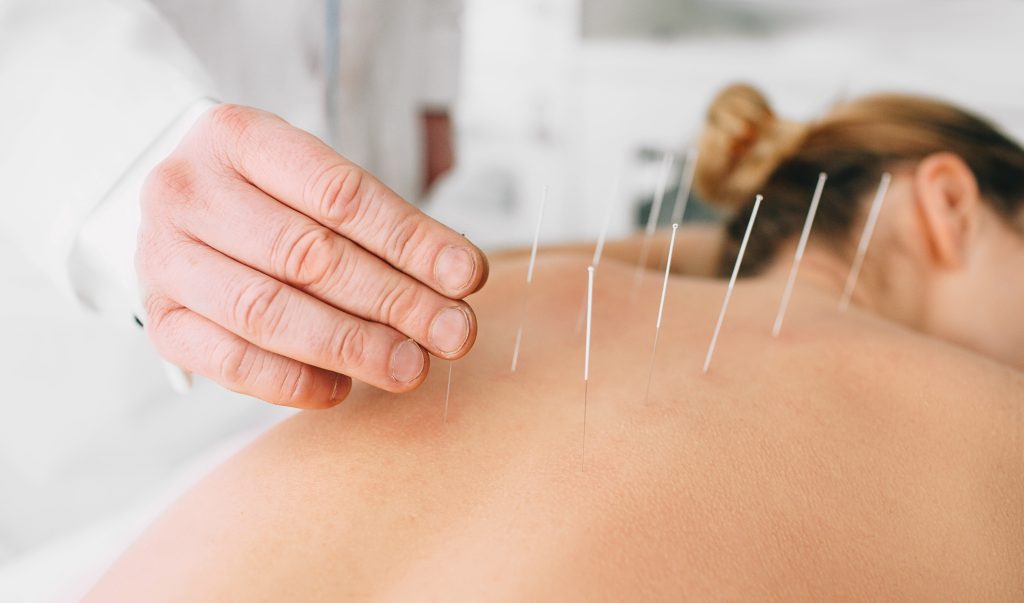
Dry needling and acupuncture can look remarkably similar. Both involve placing very fine needles through the skin, and practitioners may even use the same type of sterile, solid filiform needle.
But are dry needling and acupuncture actually the same thing?
No. Dry needling and acupuncture are not generally considered the same treatment. They may use similar or identical needles, but the reasoning behind where the needles are placed, why they are used, and what the treatment is intended to address can differ.
Dry needling is commonly used within musculoskeletal care and rehabilitation, while acupuncture has its own established clinical framework and long history within Chinese medicine. There can also be overlap between the two, which is one reason the distinction is not always as simple as it first appears.
Dry Needling vs Acupuncture at a Glance
The easiest way to understand the difference is to compare how each approach uses the needle.
| Dry Needling | Acupuncture |
| Commonly used within musculoskeletal care | Has a broader traditional treatment framework |
| Often targets muscles, soft tissues, and trigger points | Uses recognised acupuncture points |
| Point selection commonly follows anatomy and physical assessment | Point selection depends on the acupuncture assessment and approach |
| May involve moving the needle or seeking a muscle twitch | Needles are often retained in selected points |
| Frequently used alongside exercise and rehabilitation | May be used independently or alongside other care |
| Can involve superficial or deeper techniques | Can also involve different insertion depths and techniques |
| Uses thin, solid, sterile needles | Uses thin, solid, sterile needles |
| Nothing is injected | Nothing is injected |
The biggest difference is therefore not necessarily what the needle looks like, but how and why the practitioner uses it.
What Is Dry Needling?
Dry needling is a technique commonly used to address musculoskeletal pain, muscle sensitivity, tightness, and movement problems.
A trained practitioner inserts a fine, solid needle into or near selected muscle or soft tissue. Some approaches focus specifically on myofascial trigger points, which are sensitive areas within tight bands of muscle that may be associated with local or referred pain.
The term “dry” means that no medication or liquid is injected. The needle itself provides the stimulation.
Dry needling is often incorporated into a broader treatment plan involving strengthening, mobility work, exercise, manual therapy, or other forms of rehabilitation rather than being used as a stand-alone solution.
What Is Acupuncture?
Acupuncture is a needling practice with historical roots in Chinese medicine.
Traditional acupuncture involves placing needles at selected acupuncture points. Within traditional Chinese medicine, those points are understood through concepts such as meridians, qi, and patterns of imbalance.
Modern acupuncture practice can be more varied. Some practitioners work primarily within traditional frameworks, while others also use contemporary explanations involving anatomy, sensory nerves, connective tissue, pain processing, and nervous-system responses.
Acupuncture is commonly used for pain and other health concerns, although the strength of scientific evidence varies considerably depending on the condition being treated.
This broader clinical framework is one of the main differences between acupuncture and dry needling.
Do Dry Needling and Acupuncture Use the Same Needles?
They can use the same or very similar types of needles.
Both commonly use fine, solid filiform needles rather than the hollow needles used to give injections.
Professional acupuncture needles are available in different lengths and diameters and may be used across a variety of qualified clinical needling techniques.
Regardless of the treatment style, professional needles should be sterile and single-use.
The similarities in equipment explain why someone watching the two treatments may struggle to tell them apart. A dry needling needle and an acupuncture needle can look virtually identical.
What changes is the clinical reasoning behind the needle.
The Main Difference Is Why the Needle Is Placed
Imagine two practitioners placing a needle into a similar area of the shoulder.
The dry needling practitioner may have identified a sensitive band of muscle that reproduces the patient’s familiar pain. The needle is selected and positioned based on anatomy, palpation, symptoms, and the goal of stimulating that particular tissue.
An acupuncture practitioner may select a point in the same general area because it is a recognised acupuncture point chosen according to their assessment and treatment framework.
The physical location may occasionally overlap, yet the practitioners may have reached that location for different reasons.
This is why describing dry needling as simply “acupuncture with another name” misses an important part of the picture.
Trigger Points and Acupuncture Points Are Not Exactly the Same Thing
A myofascial trigger point is generally described as a sensitive area within muscle tissue. Pressing it may reproduce pain locally or cause discomfort to be felt somewhere else.
Dry needling practitioners may identify these areas through physical examination and use them as treatment targets.
An acupuncture point belongs to an established acupuncture point system. Point selection can consider the location of symptoms, broader patterns identified during assessment, and the practitioner’s particular acupuncture approach.
There is some anatomical overlap between recognised acupuncture points and locations described as trigger points.
That does not make the two systems identical. It simply helps explain why the same area of the body may sometimes be needled during either treatment.
Does Dry Needling Go Deeper Than Acupuncture?
Dry needling can involve deeper needle placement when the tissue being targeted lies within a muscle, but it is not accurate to say that dry needling is always deeper than acupuncture.
Some dry needling approaches are superficial. Some acupuncture techniques also involve deeper insertion.
Depth depends on several factors, including the body area, anatomy, treatment technique, selected tissue, and professional judgment. The same considerations are important when determining acupuncture needle insertion depth, as different treatment points require different approaches depending on the surrounding anatomical structures.
During dry needling, the needle may sometimes be moved gently within the tissue or used in a brief in-and-out technique. A local twitch response may occur when a sensitive area of muscle is stimulated.
During acupuncture, needles are often placed at selected points and retained for a period of time, although techniques vary between practitioners and styles.
There is no single needle depth or insertion technique that defines every dry needling or acupuncture treatment.
Do the Treatments Feel Different?
They can.
With dry needling, initial insertion may barely be noticed because the needles are so fine. When a sensitive muscle or trigger point is reached, however, someone may experience a quick twitch, dull ache, cramping sensation, or brief discomfort.
Muscle soreness afterward is also possible.
Acupuncture sensations vary according to the points and technique being used. People may notice pressure, heaviness, tingling, aching, warmth, or very little sensation at all.
Neither treatment should be described as universally painful or completely painless. Individual sensitivity, technique, needle depth, and treatment area all influence the experience.
What Are Dry Needling and Acupuncture Used For?
There is overlap, particularly when it comes to musculoskeletal pain.
Dry needling is commonly incorporated into treatment for problems involving muscle pain, movement restriction, muscle tightness, and some sports or overuse complaints.
Acupuncture is also commonly used for musculoskeletal pain, including back, neck, and joint-related symptoms. Acupuncture practitioners may additionally work with a broader range of health concerns depending on their professional scope and treatment approach.
The important point is that neither treatment should be presented as a cure-all.
A practitioner should first assess the person’s symptoms and determine whether needling is appropriate as part of their overall care.
What Does the Research Say?
Research into both acupuncture and dry needling continues to develop.
For dry needling, studies have reported potential short-term improvements in pain and range of motion for some musculoskeletal conditions. Evidence for longer-term outcomes is less consistent, and dry needling is frequently studied or delivered alongside exercise and other rehabilitation strategies.
Acupuncture has a much larger research literature because it has been studied for more conditions and over a longer period. Evidence is stronger for some pain-related applications than for many of the broader claims sometimes associated with acupuncture.
It is therefore difficult to make a useful statement that one technique simply “works” while the other does not.
The evidence depends on the problem being treated, the outcome being measured, the quality of the research, and what other treatment is being provided.
Are the Safety Risks Different?
Because both treatments involve inserting needles through the skin, they share several safety considerations.
Temporary soreness, small amounts of bleeding, minor bruising, and occasional light-headedness can occur with needling.
More serious complications are uncommon but possible. Deep needling around the chest or upper back, for example, carries a risk of pneumothorax if the lung is accidentally reached.
Safe treatment therefore depends on practitioner training, anatomical knowledge, appropriate patient screening, careful technique, and infection control.
The physical needle matters as well.
Professional needling should use sterile, single-use products that remain sealed until required. Understanding how often acupuncture needles should be replaced is equally relevant to dry needling, since both procedures require a fresh sterile needle for each use. Once removed, used needles must be discarded into an appropriate sharps container rather than cleaned or reused.
You can learn more about professional infection control in our guide to needle sterilisation.
Needle Selection Can Differ Between Treatments
Both dry needling and acupuncture practitioners may select from multiple needle lengths and diameters.
A dry needling practitioner may consider factors such as muscle depth, body area, patient build, treatment technique, and sensitivity.
An acupuncture practitioner may also choose different sizes according to the point, anatomical location, technique, and intended treatment.
Professional ranges such as the DB100 needles provide multiple sizes for qualified practitioners working across different needling applications.
There is no universal “dry needling needle” or “acupuncture needle” that is appropriate for every treatment.
Who Performs Dry Needling and Acupuncture in Australia?
Practitioner qualifications are another important distinction.
In Australia, acupuncturist is a protected professional title. Registered practitioners who use the title must meet the applicable registration requirements.
Dry needling is commonly used by appropriately trained health professionals as part of musculoskeletal practice. The practitioner’s ability to provide dry needling depends on their profession, training, scope of practice, and applicable professional requirements.
For patients, the practical question should not simply be whether someone owns acupuncture needles.
It is reasonable to ask about their professional registration, specific needling education, clinical experience, infection-control procedures, and whether the technique is appropriate for the problem being treated.
So, Is Dry Needling a Form of Acupuncture?
This question is more complicated than it initially appears.
The treatments share an obvious physical technique: inserting fine filiform needles through the skin. Some treatment locations can also overlap.
However, in modern clinical practice, dry needling is generally taught and described as a distinct musculoskeletal technique with its own assessment and treatment reasoning.
Acupuncture has a much longer historical tradition and its own systems of point selection, diagnosis, and clinical practice.
It is therefore more useful to recognise their overlap while understanding that using a similar needle does not automatically make two treatments the same.
Frequently Asked Questions
What is the main difference between dry needling and acupuncture?
The main difference is the reasoning behind needle placement. Dry needling commonly targets muscles, soft tissues, and trigger points identified through musculoskeletal assessment. Acupuncture selects recognised acupuncture points according to the practitioner’s acupuncture framework.
Are dry needling needles the same as acupuncture needles?
They can be. Both treatments commonly use fine, solid filiform needles that are sterile and single-use. The physical needle may be identical even when the clinical technique is different.
Why is dry needling called “dry”?
It is called dry needling because nothing is injected through the needle. The needle is solid rather than hollow and contains no medication or liquid.
Does dry needling go deeper than acupuncture?
Sometimes, but not always. Dry needling may reach deeper muscle tissue when required, while many acupuncture treatments involve shallower retained needles. Both techniques can use different depths depending on the area and approach.
Does dry needling hurt more than acupuncture?
Dry needling can produce a brief twitch, ache, or cramping sensation when muscle tissue is stimulated, and temporary soreness can follow. Acupuncture sensations also vary. Neither technique feels exactly the same for every person.
Are acupuncture and dry needling both used for muscle pain?
Yes. Both may be used in the management of musculoskeletal pain, although the assessment process, treatment goals, and way the needles are selected can differ.
Can the same point be used in acupuncture and dry needling?
Sometimes. Research and clinical observation have identified overlap between some myofascial trigger-point locations and recognised acupuncture points. Similar location does not necessarily mean the practitioners are using the point for the same reason.
Are dry needling and acupuncture needles reusable?
No. Professional clinical needles should be sterile and single-use. Once a needle has been used, it should be disposed of appropriately and never reused.
Which is better, dry needling or acupuncture?
There is no single answer that applies to everyone. The appropriate approach depends on the person’s symptoms, treatment goals, underlying problem, practitioner assessment, and the evidence for the condition being treated.
Final Thoughts
Dry needling and acupuncture may look similar because both can use the same thin, solid filiform needles. However, they are not generally considered the same treatment.
Dry needling is commonly used within a musculoskeletal framework, with practitioners selecting muscles, trigger points, or other tissues according to anatomy and physical assessment. Acupuncture uses its own recognised points and clinical frameworks, with historical roots in Chinese medicine and a wider range of modern practice styles.
There is genuine overlap between the two, including the equipment used and some treatment locations. The clearest difference lies in the reasoning behind the needle placement and how the technique fits into the practitioner’s overall approach.
Whichever treatment is used, appropriate professional training, good anatomical knowledge, sterile single-use needles, and responsible clinical assessment remain essential.