
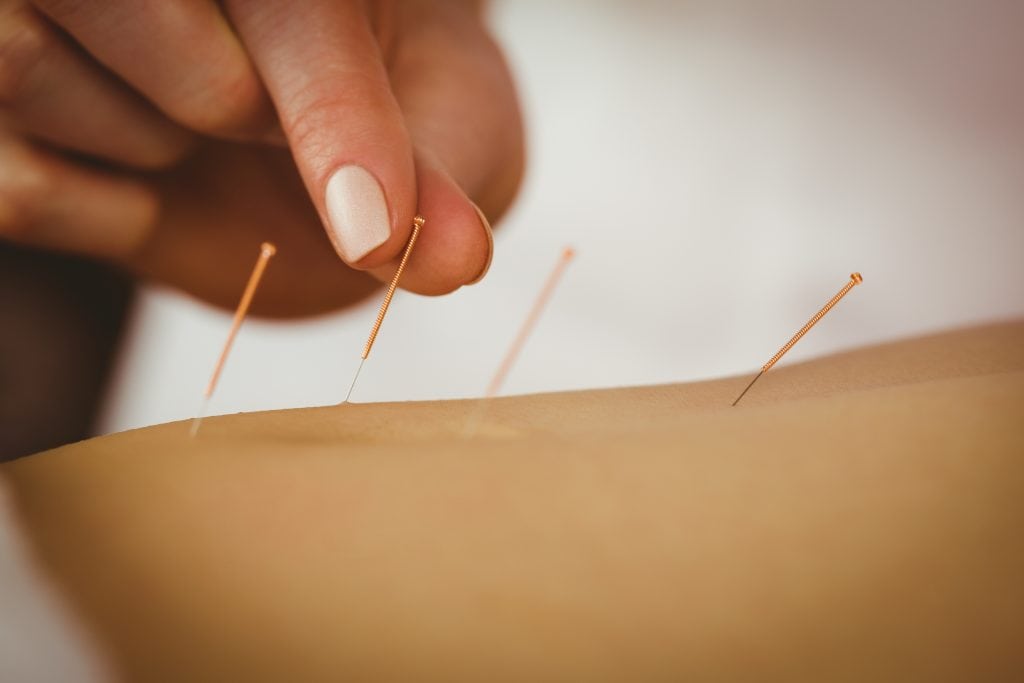
Dry needling is a treatment technique in which a trained healthcare practitioner inserts thin, solid needles into or near selected muscles and myofascial trigger points. It is commonly used as part of a broader approach to managing musculoskeletal pain, muscle tightness, and movement limitations.
The word “dry” means that nothing is injected through the needle. Unlike the hollow needles used for injections, dry needling typically uses fine, solid filiform needles. Although dry needling and acupuncture can use similar physical needles, the way they are assessed, selected, and used can differ.
What Is Dry Needling?
Dry needling is a musculoskeletal treatment technique that uses thin, solid needles to stimulate selected muscles, connective tissues, or myofascial trigger points. No medication or liquid is injected during the procedure, which is why the technique is described as “dry.”
Practitioners may use dry needling to help manage muscle tightness, pain, sensitivity, and restricted movement. It is often incorporated into a broader rehabilitation program that may also include exercise, stretching, strengthening, manual therapy, or movement-based treatment.
Professional dry needling should use sterile, single-use needles that are disposed of after treatment. Depending on the area being treated and the technique used, a person may experience a brief muscle twitch, mild discomfort, temporary soreness, or minor bruising.
While dry needling and acupuncture may use similar fine needles, they are not necessarily the same treatment. Their clinical reasoning, assessment methods, and treatment goals can differ.
Why Trigger Points Matter in Dry Needling
Much of dry needling focuses on areas known as myofascial trigger points.
A trigger point is generally described as a sensitive or tender area within a tight band of muscle. Pressure or stimulation of the area may cause discomfort directly at the site or somewhere else in the body.
Pain felt away from the original point is known as referred pain.
Practitioners assess these areas alongside movement, medical history, symptoms, and other clinical findings before deciding whether dry needling may be appropriate. Similar principles are discussed in motor point needling for plantar fasciitis, where muscular involvement and specific treatment points are considered when addressing foot discomfort.
Dry needling should therefore not be viewed simply as placing a needle wherever someone feels pain. Proper assessment and anatomical knowledge are important parts of the process.
How Does Dry Needling Work?
Dry needling mechanically stimulates selected muscle and soft tissue.
When a needle reaches a sensitive area, the muscle may sometimes produce a brief contraction known as a local twitch response. Some dry needling techniques are designed to produce this response, although not every treatment requires one.
Researchers have proposed several possible mechanisms for dry needling, including changes in muscle activity, local circulation, sensory nerve signalling, and pain processing.
The technique is sometimes described as “releasing muscle knots,” but that description can oversimplify what happens. Dry needling appears to involve interactions between muscle tissue, sensory nerves, and the nervous system rather than physically breaking apart a knot.
Current research continues to investigate exactly how these responses contribute to changes in pain and movement.
What Happens During a Dry Needling Session?
A dry needling session normally starts with assessment rather than immediate needle placement.
The practitioner may review symptoms, medical history, movement restrictions, previous injuries, and treatment goals. They may then examine the affected area and identify muscles or tissues that could be contributing to the problem.
If dry needling is considered appropriate, the selected area is prepared according to suitable infection-control procedures.
The practitioner selects an appropriate needle according to the body area, tissue depth, technique, and their professional judgment. The acupuncture needles commonly used for professional needling are fine, solid filiform needles rather than hollow injection needles.
The needle may then be inserted into or near the selected tissue. Depending on the technique, it may remain still, be manipulated briefly, or be inserted and withdrawn.
Once treatment is complete, every used needle should be discarded immediately into an appropriate sharps container.
How Deep Do Dry Needling Needles Go?
Dry needling can involve superficial or deeper needle placement.
Superficial techniques target tissues closer to the surface, while deeper techniques may reach underlying muscle tissue. The appropriate depth depends on anatomy, treatment area, technique, and professional assessment.
There is no single insertion depth that is suitable for every person or body area.
This is one reason dry needling should only be performed by someone with appropriate training in anatomy, safe needling techniques, and clinical assessment.
How Long Are Dry Needling Needles Left In?
There is no universal treatment time for dry needling.
In some techniques, a needle may be inserted for only a few seconds. In others, it may remain in position for several minutes. Clinical descriptions include treatment approaches where needles remain in place for up to around 20 minutes.
The treatment time depends on the technique, target tissue, treatment plan, and individual response.
What Does Dry Needling Feel Like?
People experience dry needling differently.
Because the needles are very fine, some people barely notice the initial insertion. Others may feel a brief prick.
When a sensitive muscle or trigger point is stimulated, sensations can include a quick twitch, dull ache, pressure, cramping, or brief discomfort.
A person may occasionally feel a sensation somewhere away from the needle site because trigger points can be associated with referred pain.
Temporary soreness after treatment is also common. Cleveland Clinic notes that people may experience tightness or soreness around the insertion area following treatment.
What Is Dry Needling Used For?
Dry needling is mainly used within musculoskeletal care.
Practitioners may consider it as part of treatment for problems involving muscle pain, tightness, or movement restrictions, including:
- neck and shoulder discomfort
- back pain
- muscle strains
- sports-related muscle problems
- repetitive-use complaints
- certain tendon-related conditions
- some headache presentations
- jaw or TMJ-related muscular discomfort
- restricted range of motion
Clinical sources also describe its use for conditions such as tendinitis, whiplash, repetitive-motion problems, spinal issues, and certain headache disorders.
Dry needling is generally used as one part of a broader treatment plan rather than as a stand-alone solution.
What Are the Potential Benefits of Dry Needling?
Dry needling may help some people manage musculoskeletal pain and movement restrictions.
Potential benefits include short-term reductions in pain, decreased muscle sensitivity or tightness, and improvements in range of motion.
For some people, reducing discomfort may also make it easier to participate in strengthening, mobility work, exercise, or other parts of rehabilitation.
The response varies from person to person. Some people notice a change quickly, while others may require more than one treatment or may experience little benefit.
Dry needling is therefore better viewed as a clinical tool that can complement rehabilitation rather than a guaranteed cure for pain or injury.
Why the Needle Itself Matters
The physical needle is an important part of professional dry needling.
Dry needling generally uses fine, solid filiform needles made from stainless steel. They are available in different lengths and diameters because different treatment areas and techniques require different equipment.
Practitioners may consider tissue depth, body area, patient build, technique, sensitivity, handle design, and guide-tube preference when selecting a needle.
Products such as the DB100 needle are available in multiple professional sizes, giving trained practitioners options for different clinical applications.
Longer or thicker needles are not automatically better. Appropriate needle selection depends on anatomy, professional training, and treatment requirements.
Sterility and Single Use Are Essential
Because dry needling penetrates the skin, infection control is an essential part of safe practice.
Professional needles should be sterile, kept sealed until required, and checked to ensure the packaging has not been damaged.
They should also be used only once.
Once a needle has been used, it should be disposed of immediately in an appropriate medical sharps container. It should never be cleaned and reused for the same person or another patient.
Cleveland Clinic describes dry needling needles as sterile, disposable, and single-use.
Our guide to needle sterilisation explains professional sterilisation and needle-safety considerations in more detail.
What Happens After Dry Needling?
Temporary soreness is one of the most common experiences following dry needling.
The treated muscle may feel similar to how it feels after exercise. Some people may also notice mild stiffness, tenderness, bruising, a small amount of bleeding, fatigue, or temporary light-headedness.
Cleveland Clinic notes that post-treatment soreness may persist for around 24 to 36 hours in some people, while bruising can occasionally last longer.
The practitioner may provide aftercare recommendations based on the treatment performed and the person’s wider rehabilitation plan.
Unexpected, severe, or persistent symptoms should be discussed with an appropriate healthcare professional.
What Are the Risks of Dry Needling?
Dry needling is invasive, even though the needles are very fine.
Common side effects tend to be minor and can include soreness, stiffness, bruising, fatigue, and occasional faintness.
There is also a potential risk of infection if appropriate sterile technique and infection-control procedures are not followed.
More serious complications are uncommon but possible. One example is pneumothorax, or a collapsed lung, which can occur if a needle reaches the lung during treatment around the chest or upper back.
These risks reinforce why dry needling should be carried out only by appropriately trained practitioners with a detailed understanding of anatomy.
Who Should Be Careful With Dry Needling?
Dry needling may not be appropriate for everyone.
People who are pregnant, taking blood-thinning medication, recovering from recent surgery, living with a compromised immune system, or experiencing significant needle fear should discuss their circumstances with an appropriate healthcare professional before treatment.
Individual health conditions and medications may also influence whether dry needling is suitable.
A professional assessment is therefore important before deciding to proceed.
Dry Needling vs Acupuncture
Dry needling and acupuncture can use similar or even the same types of fine, solid needles, but they are not necessarily performed within the same clinical framework.
Dry needling is commonly associated with musculoskeletal assessment and may focus on muscle tissue, trigger points, pain patterns, and movement limitations.
Acupuncture has its own historical development, diagnostic approaches, treatment principles, and professional framework.
There can also be anatomical overlap between some acupuncture points and areas targeted during dry needling.
The easiest way to understand the distinction is that the physical needles may be similar, but the reasoning behind where, why, and how they are used can differ.
Frequently Asked Questions About Dry Needling
Why is it called dry needling?
It is called dry needling because nothing is injected into the body. The technique uses a solid needle without medication or liquid, unlike trigger-point injections or other procedures that use hollow needles.
Are dry needling needles the same as acupuncture needles?
They can be the same or very similar types of fine, solid filiform needles. The main difference is usually the clinical approach and how the practitioner selects and uses the needle.
Are dry needling needles reusable?
No. Professional dry needling needles should be sterile and single-use. Once used, they should be placed in an appropriate sharps container and never reused.
Does dry needling hurt?
Some people feel very little during insertion, while others may notice a brief prick, twitch, ache, pressure, or cramping sensation. Temporary soreness following treatment can also occur.
How deep do dry needling needles go?
Needle depth depends on the treatment area, anatomy, technique, and practitioner’s assessment. Some dry needling is superficial, while other techniques reach deeper muscle tissue.
How long are dry needling needles left in?
The time varies considerably. Some techniques involve only brief insertion, while other treatments may leave needles in place for several minutes.
How long does soreness last after dry needling?
Temporary soreness may last through the day of treatment or into the following day. Some people may experience soreness for around 24 to 36 hours, although responses vary.
Can dry needling cause bruising?
Yes. Minor bruising can occur around a needle insertion site. It is generally a temporary side effect.
Does dry needling work immediately?
Some people report changes in pain or movement soon after treatment, while others require multiple sessions or experience less noticeable effects. There is no guaranteed immediate response.
Is dry needling safe?
Dry needling is generally considered a low-risk procedure when performed appropriately by a trained practitioner, but it is not risk-free. Minor soreness and bruising are more common, while serious complications are uncommon.
Can anyone perform dry needling?
No. Dry needling requires appropriate professional training, anatomical knowledge, infection-control procedures, and safe needle-handling skills. Practitioners should work within their professional scope and relevant local requirements.
Final Thoughts
Dry needling is a musculoskeletal treatment technique that uses thin, sterile, solid needles to stimulate selected muscles, soft tissues, and myofascial trigger points.
It may be used to help manage pain, muscle tightness, sensitivity, and restricted movement, often alongside exercise, strengthening, manual therapy, or other rehabilitation strategies.
Treatment can involve different needle sizes, depths, and techniques, and temporary soreness or bruising may occur afterward.
Most importantly, successful and safe dry needling involves much more than inserting a needle. Appropriate assessment, anatomical knowledge, sterile single-use equipment, careful needle selection, and professional training are all essential parts of responsible clinical practice.