
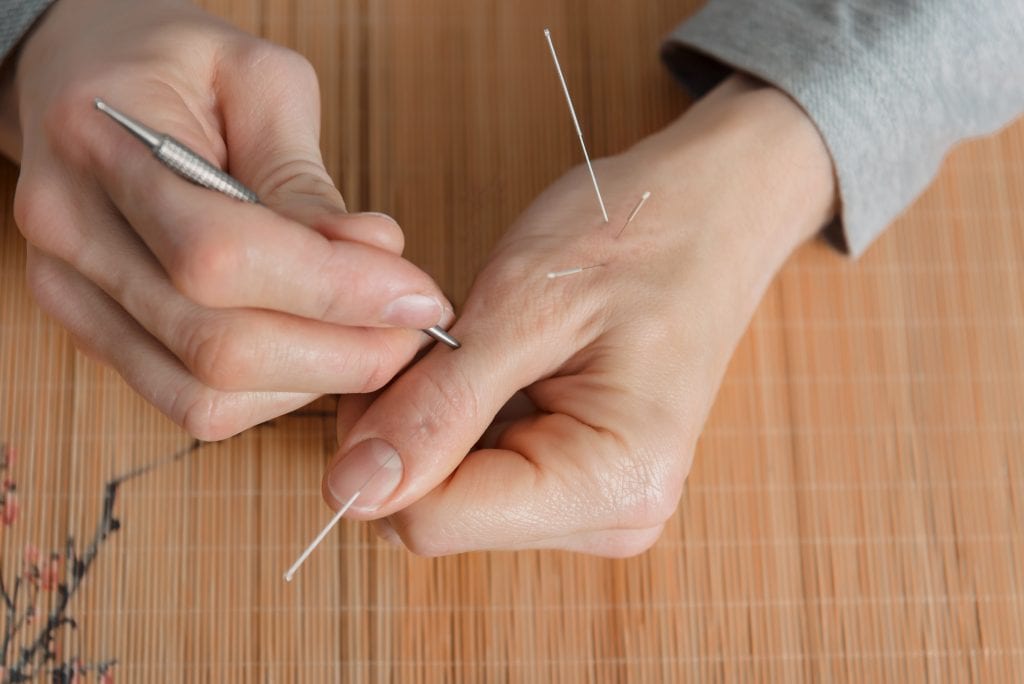
Acupuncture needles are inserted by a trained practitioner after locating the appropriate acupuncture point and selecting a suitable sterile, single-use needle. The practitioner may use a guide tube or a trained freehand technique for the initial insertion. The appropriate angle, depth, and any further needle manipulation depend on the point, surrounding anatomy, patient factors, and treatment approach.
Although acupuncture needles are extremely fine, inserting them safely requires detailed knowledge of anatomy, point location, infection control, needle selection, and clinical technique. The process involves much more than simply placing a needle where symptoms are felt.
Because acupuncture penetrates the skin, needle insertion should only be performed by appropriately trained practitioners or students working under suitable clinical supervision.
How Are Acupuncture Needles Inserted?
Professional acupuncture needle insertion begins with assessment and accurate point location.
Once the practitioner has selected an acupuncture point, they choose an appropriate needle and prepare the area according to relevant infection-control procedures. The needle may then be introduced with a guide tube or by a trained freehand technique, depending on the practitioner’s education, clinical approach, and preferred method.
After the initial insertion, the practitioner may position the needle further according to the treatment plan. Some needles remain relatively still, while others may receive gentle manual stimulation.
There is no single insertion technique that applies to every acupuncture point. Skin thickness, muscle depth, nearby anatomical structures, patient sensitivity, and the intended treatment can all affect how the needle is used.
What Happens Before an Acupuncture Needle Is Inserted?
Needle insertion begins before the needle touches the skin.
A practitioner typically reviews the patient’s health history, current symptoms, treatment goals, and any factors that could influence needling safety.
The selected acupuncture point is then identified using the practitioner’s point-location system, which may involve anatomical landmarks, proportional measurements, and palpation.
The anatomy beneath the intended point must also be considered carefully. Areas close to important nerves, blood vessels, organs, or other sensitive structures require appropriate knowledge and clinical judgment.
Finally, the practitioner selects a needle suited to the area and intended technique.
Professional acupuncture needles are available in different lengths, diameters, handle styles, and guide-tube configurations for different clinical applications.
How Do Practitioners Locate Acupuncture Points?
Acupuncture points are not selected simply by inserting a needle wherever someone feels discomfort.
Practitioners learn established point locations and use anatomical landmarks, proportional measurements, palpation, and their clinical assessment to identify the intended site.
A point may be located in relation to:
- bones and joints
- muscles and tendons
- skin creases
- other anatomical landmarks
- proportional body measurements
Palpation may also help confirm the selected area before needling.
Accurate point location requires professional education and practical training. Charts and diagrams can provide reference information, but they are not substitutes for anatomical knowledge and supervised clinical experience.
How Is the Right Acupuncture Needle Selected?
There is no single acupuncture needle suitable for every point or patient.
Practitioners may consider:
- treatment area
- tissue depth
- patient sensitivity
- needle length
- needle diameter
- handle design
- guide-tube preference
- intended treatment technique
Shorter or finer needles may be preferred for some superficial or sensitive areas, while other clinical applications may require a different size.
Needle selection should be based on professional assessment rather than assuming that a longer or thicker needle provides a stronger or more effective treatment.
Inserting Acupuncture Needles With a Guide Tube
A guide tube is commonly used to help control the initial placement of an acupuncture needle.
The tube is slightly shorter than the needle, leaving part of the handle accessible above it. The practitioner positions the tube over the selected point so the needle can be stabilised during the initial insertion.
Guide tubes may assist with:
- needle stability
- controlled placement
- consistent handling
- practitioner accuracy
- reducing unnecessary movement at the skin surface
After the initial insertion, the guide tube is removed and the practitioner continues according to the chosen needling technique.
Products such as the DB100 acupuncture needle are supplied with individual guide tubes for professional clinical use.
Can Acupuncture Needles Be Inserted Without a Guide Tube?
Yes. Appropriately trained practitioners may use freehand insertion techniques without a guide tube.
Freehand needling depends heavily on hand control, positioning, training, and familiarity with the needle.
Different approaches may involve stabilising or gently supporting the surrounding tissue while controlling the needle during insertion.
Neither guide-tube nor freehand insertion is automatically better in every situation. Practitioner training, acupuncture style, needle design, body area, and treatment technique can all influence the preferred approach.
Guide Tube vs Freehand Insertion
| Guide Tube | Freehand |
| Helps stabilise the needle | Relies on practitioner hand control |
| Common with many modern disposable needles | Used in several acupuncture traditions and techniques |
| Supports controlled initial placement | Requires developed coordination and practical skill |
| Tube is removed after insertion | No guide tube is required |
| Useful across many clinical applications | Choice depends on practitioner technique |
What Determines the Angle of Needle Insertion?
Acupuncture needles are not always inserted at the same angle.
Depending on the selected point and anatomy, practitioners may use more perpendicular, oblique, or superficial approaches.
The chosen direction may depend on:
- underlying anatomy
- tissue thickness
- treatment area
- intended technique
- patient build
- practitioner assessment
The key consideration is not following one universal insertion angle. Safe acupuncture requires understanding the structures beneath the point and adapting the technique accordingly.
This becomes especially important in anatomical areas where incorrect direction could increase the risk of injury.
How Deep Are Acupuncture Needles Inserted?
Acupuncture needle depth varies considerably.
Some points may require relatively superficial placement, while others involve deeper tissues. Appropriate depth depends on the point, individual anatomy, treatment approach, and needle selected.
There is therefore no single insertion depth that is appropriate for every acupuncture point or every patient.
Body size and tissue thickness can also differ significantly between people, meaning the same external point may not have the same underlying depth in every patient.
Safe depth determination requires anatomical and clinical training rather than general online instructions.
What Happens After the Needle Is Inserted?
Once positioned, the needle may either remain relatively still or receive controlled stimulation depending on the treatment method.
Professional techniques can include:
- gentle rotation
- controlled lifting and lowering
- brief manual stimulation
- leaving the needle undisturbed
- other techniques used within the practitioner’s acupuncture approach
Not every inserted needle needs to be manipulated.
The type and amount of stimulation depend on the selected point, treatment strategy, patient response, and practitioner training.
Why Do Acupuncturists Twist or Move Needles?
Practitioners may gently manipulate an acupuncture needle to change or increase stimulation at the selected point.
Traditional acupuncture systems describe different forms of needle manipulation according to the treatment strategy. Contemporary practitioners may also consider patient sensation and the level of stimulation appropriate for the area.
Some needles may be rotated or otherwise stimulated briefly, while others are simply inserted and retained.
Needle manipulation is therefore a clinical choice rather than a required step for every point.
What Does Acupuncture Needle Insertion Feel Like?
Many people find acupuncture needle insertion much less noticeable than expected because the needles are extremely fine and solid.
Possible sensations include:
- little or no sensation during insertion
- a brief prick
- pressure
- dull aching
- heaviness
- warmth
- tingling
- a spreading sensation
Some of these sensations may be associated with what traditional acupuncture describes as de qi.
The experience varies depending on the patient, treatment area, needle size, depth, and technique.
Sharp or persistent pain should not simply be ignored. Patient feedback is an important part of treatment, and the practitioner can adjust or remove a needle if necessary.
How Long Are Acupuncture Needles Left In?
There is no universal needle-retention time.
Some acupuncture techniques involve relatively brief stimulation, while others leave needles in position for longer before removal.
Retention time may depend on:
- acupuncture style
- selected points
- treatment objectives
- patient response
- overall clinical plan
The practitioner determines the appropriate approach rather than following one fixed time for every treatment.
Why Sterile, Single-Use Acupuncture Needles Matter
Acupuncture penetrates the skin, so infection prevention is a fundamental part of professional practice.
Acupuncture needles should be supplied sterile and remain sealed until they are required.
Once used, a needle should not be cleaned and inserted again.
Professional infection-control practices include:
- appropriate hand hygiene
- maintaining clean needle handling
- protecting needle sterility before insertion
- suitable skin preparation where required
- using each needle only once
- immediate sharps disposal after removal
Our guide to needle sterilisation explains professional needle safety and sterilisation considerations in more detail.
Can Acupuncture Needles Be Reused?
No. Modern professional acupuncture needles should be sterile and single-use.
Once a needle has penetrated the skin, it should be disposed of appropriately after treatment.
It should not be wiped, reprocessed, or saved for later use.
Single-use needles help reduce the risk of cross-contamination and are an essential part of modern professional acupuncture practice.
What Happens When Acupuncture Needles Are Removed?
Needle removal is also performed in a controlled manner.
After the treatment period, the practitioner removes each needle and checks the area for an immediate skin response.
A small pinpoint of blood may occasionally appear, while minor bruising or temporary tenderness can also occur.
Every removed needle should be placed directly into an appropriate sharps container.
Practitioners should also account for the needles used during treatment so none are accidentally left behind.
Possible Side Effects of Acupuncture Needle Insertion
Acupuncture is generally considered low risk when performed appropriately by a suitably trained practitioner using sterile, single-use needles.
Temporary effects may include:
- minor bleeding
- small bruises
- temporary tenderness
- soreness
- light-headedness
- fatigue
More serious complications are uncommon but possible.
Poor infection-control procedures can increase infection risk, while inappropriate depth or direction can potentially injure underlying structures.
This is why anatomical knowledge, correct needle selection, safe insertion technique, and appropriate practitioner training matter.
Who Should Insert Acupuncture Needles?
Acupuncture needles should be inserted by appropriately trained practitioners working within their qualifications and applicable professional requirements.
Safe professional needling requires knowledge of:
- human anatomy
- acupuncture point location
- needle selection
- safe insertion principles
- infection prevention
- contraindications
- patient assessment
- management of adverse reactions
Simply owning acupuncture needles or knowing the general location of acupuncture points does not provide sufficient training to perform acupuncture safely.
Students learning acupuncture should develop insertion skills through appropriate education and supervised clinical practice.
Frequently Asked Questions About Acupuncture Needle Insertion
How are acupuncture needles inserted?
A trained practitioner locates the intended acupuncture point, selects an appropriate sterile needle, and performs the initial insertion using either a guide tube or a trained freehand technique. Subsequent positioning depends on the point, anatomy, and treatment approach.
Do acupuncture needles need a guide tube?
No. Guide tubes are commonly used to provide stability and control during initial insertion, but experienced practitioners may also use freehand techniques.
How deep are acupuncture needles inserted?
The appropriate depth depends on the acupuncture point, patient anatomy, treatment technique, and selected needle. There is no universal depth suitable for every point.
Are acupuncture needles inserted straight in?
Not always. Needle direction varies according to the point, anatomical structures beneath it, and the technique being used.
Does acupuncture needle insertion hurt?
Many people feel little during initial insertion. Others may notice a brief prick followed by sensations such as pressure, dull aching, warmth, heaviness, or tingling.
Why do acupuncturists twist the needles?
Some practitioners gently rotate or otherwise stimulate needles as part of their treatment method. Other needles may remain still throughout the treatment.
How long do acupuncture needles stay in?
Retention time varies between treatments. Some techniques involve brief stimulation, while others retain needles for a period before removal.
Are acupuncture needles hollow?
No. Standard acupuncture needles are fine, solid filiform needles rather than hollow hypodermic needles used to inject medication.
Can acupuncture needles be reused?
No. Professional acupuncture needles should be sterile and single-use, then disposed of in an appropriate sharps container.
Is a small amount of bleeding normal after acupuncture?
A small pinpoint of blood or minor bruising can occasionally occur after needle removal. Persistent, excessive, or unusual bleeding should be appropriately assessed.
Can you insert acupuncture needles yourself?
Acupuncture self-needling is not recommended without appropriate professional education and supervised training. Safe insertion requires knowledge of anatomy, point location, infection control, needle selection, and possible complications.
Final Thoughts
Acupuncture needle insertion is a professional clinical skill that begins with assessment, accurate point location, and appropriate needle selection.
A trained practitioner may use a guide tube or a freehand technique for the initial insertion, then adjust the needle according to the treatment approach and surrounding anatomy. Angle, depth, manipulation, and retention time can all vary between points and patients.
Throughout the process, sterile single-use needles, careful handling, patient feedback, infection control, and safe sharps disposal remain essential.
Understanding how acupuncture needles are inserted can make the treatment process easier to understand, but safe needling ultimately depends on professional training, anatomical knowledge, clinical judgment, and responsible technique.