
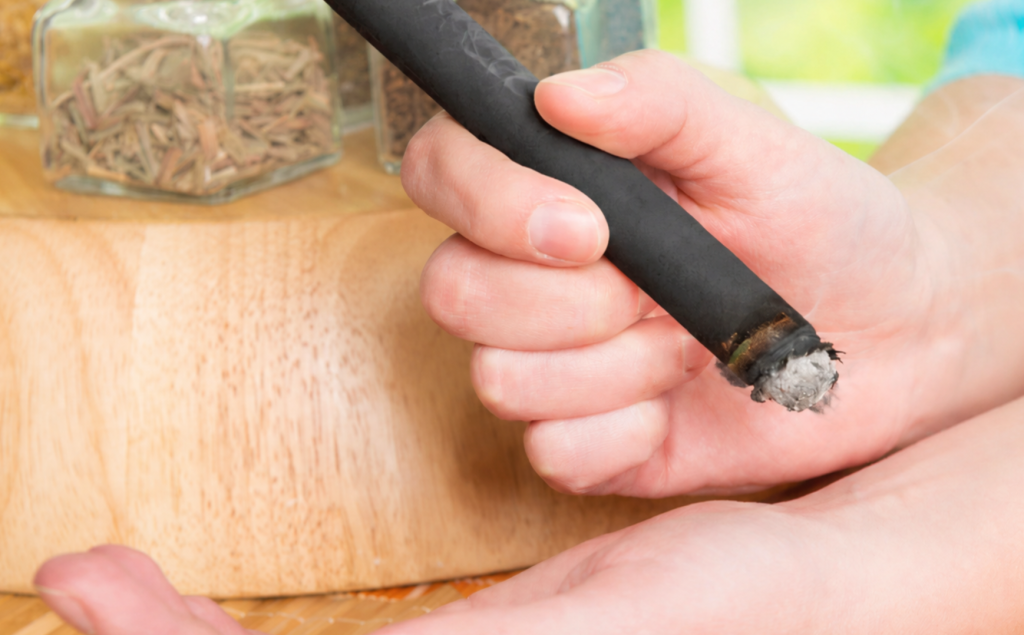
Moxa sticks are used in a form of traditional Chinese medicine called moxibustion, where dried mugwort is burned to provide controlled warmth near selected areas of the body.
If you are wondering how to use moxa sticks, the basic method is straightforward: light one end until it glows evenly, hold it a few centimetres above the skin without touching it, move it slowly to create gentle warmth, and extinguish it completely after use.
The most important rule is simple: moxa should feel comfortably warm, never painfully hot.
Because a moxa stick contains a live ember, correct handling, ventilation, and professional guidance are important, especially if you are new to moxibustion.
What Is a Moxa Stick?
A moxa stick is usually made from dried and processed mugwort, traditionally Artemisia vulgaris, compressed or rolled into a cigar-shaped stick.
When lit, the tip smoulders rather than burning with a continuous open flame. This produces heat that can be directed toward selected areas without the stick touching the skin.
Moxa sticks are most commonly used for indirect moxibustion, which means the burning material stays above the skin instead of being placed directly on it.
Different forms are available, including traditional herbal rolls and lower-smoke or charcoal-style products. You can explore professional moxa products designed for different moxibustion approaches.
What Is Moxibustion?
Moxibustion is a traditional practice that uses heat from burning moxa near acupuncture points or other selected areas.
Within traditional Chinese medicine, the warming effect is used according to concepts involving qi, meridians, and patterns of cold or deficiency.
From a modern perspective, part of the experience can also be understood as controlled local heat stimulation. Heat can influence local circulation, tissue comfort, and sensory nerve activity, although the wider therapeutic effects attributed to moxibustion are still being researched.
Moxibustion is often used alongside acupuncture but can also be performed separately.
Regular vs Smokeless Moxa Sticks
Traditional and smokeless moxa sticks work in similar ways, but the experience can be different.
Traditional Moxa Sticks
Traditional moxa sticks contain processed mugwort and usually produce a noticeable herbal aroma and visible smoke as they smoulder.
They are commonly used in well-ventilated treatment spaces.
Smokeless Moxa Sticks
Smokeless or low-smoke moxa sticks are generally more compressed or charcoal-like. They are designed to reduce smoke and odour compared with traditional rolls.
“Smokeless” does not necessarily mean completely smoke-free, so ventilation is still important.
NeedlePro also offers options such as moxa rolls intended for indirect moxibustion.
What You Need Before Using a Moxa Stick
Prepare everything before lighting the stick.
You will generally need:
- a moxa stick
- a suitable lighter or candle
- a fire-resistant ash dish
- an appropriate moxa extinguisher or fire-safe container
- a comfortable, stable place to sit
- good ventilation
Remove loose paper, curtains, bedding, clothing, and other flammable materials from the immediate area.
Once a moxa stick is lit, do not leave it unattended.
How to Use a Moxa Stick Step by Step
1. Prepare a Well-Ventilated Space
Open a window or make sure the room has good airflow before lighting traditional moxa.
Smoke can be noticeable and may irritate people who are sensitive to it.
Choose a position where you can comfortably reach the intended area without stretching awkwardly or risking dropping the stick.
2. Light One End of the Moxa Stick
Hold one end of the moxa stick over a flame until the tip begins to burn.
Once the end is well lit, remove it from the flame. The tip should continue to glow as an ember rather than maintaining a large open flame.
Some dense or smokeless varieties can take longer to light evenly.
Check that the tip is glowing properly before beginning.
3. Hold the Stick Above the Skin
Move the glowing tip toward the selected area while keeping it a few centimetres away from the skin.
The ranking guidance you supplied commonly recommends around 2 to 3 cm, but comfort and heat intensity are more important than following an exact measurement.
The stick should never touch the skin.
You should feel gentle, comfortable warmth. If it feels too hot, immediately move the stick farther away.
4. Keep the Moxa Moving
Avoid holding the glowing tip in one fixed position for too long.
Slow movement distributes heat more evenly and reduces the chance of overheating the skin.
Common techniques include circular, pecking, and sweeping movements.
5. Monitor the Heat Constantly
Pay attention to how the skin feels throughout the session.
The goal is pleasant warmth, not intense heat.
Stop or increase the distance if you notice:
- burning
- sharp discomfort
- excessive redness
- pain
- skin irritation
Do not wait until the area becomes painful before moving the stick away.
6. Continue for the Recommended Time
Moxa may be applied for several minutes depending on the selected area, technique, and practitioner instructions.
Some of the guidance you supplied describes sessions of approximately 5 to 15 minutes, but there is no universal duration suitable for every person or purpose.
If a qualified practitioner has given you a specific moxa routine, follow their instructions rather than using a general time recommendation.
7. Extinguish the Stick Completely
Once finished, place the glowing end into an appropriate moxa extinguisher or another suitable fire-safe container designed to deprive the ember of oxygen.
Do not assume the stick has gone out simply because you cannot see smoke.
Moxa can continue smouldering internally.
Always confirm that the ember is fully extinguished before leaving it unattended or storing the remaining stick.
Three Common Ways to Move a Moxa Stick
Different movement styles change how concentrated the warmth feels.
| Technique | How It Works |
| Circular | Move the stick slowly in small circles over one selected area |
| Pecking | Move the stick gradually closer to and farther from the skin |
| Sweeping | Move the stick back and forth across a broader area |
None of these techniques should involve direct skin contact.
The best method depends on the area being warmed and any guidance provided by your practitioner.
How Far Should a Moxa Stick Be From the Skin?
A moxa stick is commonly held around 2 to 3 cm above the skin during indirect moxibustion.
However, this is only a general guide.
The effective heat produced by different moxa products can vary. Wind, room temperature, stick type, and individual skin sensitivity can also change how hot the treatment feels.
Use the person’s heat sensation as an additional guide and increase the distance immediately if the warmth becomes uncomfortable.
People with reduced skin sensation require extra caution because they may not notice excessive heat soon enough.
How Long Should You Use a Moxa Stick?
There is no single correct treatment time.
General moxa-stick routines often last several minutes over a selected area, and some of the ranking guidance you provided uses approximately 5 to 15 minutes.
Treatment should end sooner if the skin becomes uncomfortable or overly hot.
The appropriate duration may vary according to:
- moxa type
- treatment area
- individual heat sensitivity
- practitioner instructions
- reason for using moxa
More time does not automatically mean greater benefit.
What Should Moxa Feel Like?
Proper indirect moxa should feel comfortably warm.
The sensation may gradually build as the area warms, but it should not become painful.
A mild warmth or gentle heating sensation is expected. Burning, stinging, or intense heat means the stick is too close or has remained over the same area for too long.
Move it farther away or stop the session.
Can a Moxa Stick Touch the Skin?
No. A moxa stick used for indirect moxibustion should not touch the skin.
The glowing tip can become extremely hot and may cause burns if direct contact occurs.
Direct moxibustion is a different technique involving burning moxa closer to or directly on the body. It carries different risks and should not be treated as a DIY extension of ordinary moxa-stick use.
For a general home guide, indirect moxibustion is the safer approach to discuss.
Safety Precautions When Using Moxa Sticks
Because moxa involves fire and heat, safe use matters as much as technique.
Keep these precautions in mind:
- never leave burning moxa unattended
- never let the glowing end touch the skin
- keep the stick moving
- maintain good ventilation
- keep flammable materials away
- remove ash safely
- stop if the heat becomes painful
- avoid broken, infected, or irritated skin
- do not use over areas where heat sensation is impaired
- fully extinguish the stick before storage
Smoke from traditional moxa can also irritate the respiratory system in some people.
People with asthma or significant smoke sensitivity should discuss suitable alternatives with a practitioner rather than assuming low-smoke moxa will automatically be appropriate.
Who Should Ask a Practitioner Before Using Moxa?
Professional advice is particularly important if you:
- are pregnant
- have reduced sensation or neuropathy
- have diabetes-related sensory changes
- have open wounds or active skin infections
- have a respiratory condition
- are very sensitive to heat
- have a complex or ongoing medical condition
- are unsure which areas or points to warm
Reduced skin sensation is especially important because a person may not recognise dangerous heat early enough to prevent a burn.
Can You Use Moxa During Pregnancy?
Moxibustion is sometimes discussed in pregnancy care, including in research involving breech presentation.
However, pregnancy is not the right time to experiment with moxa points or treatment schedules based solely on online instructions.
Some areas and protocols require specific professional consideration.
If you are pregnant, use moxibustion only after receiving guidance from an appropriately qualified healthcare practitioner who can advise on point selection, duration, and timing.
Can You Use Moxa Sticks at Home?
Moxa sticks may be used at home in some circumstances, particularly when a practitioner has already shown you where and how to use them.
The safest approach for someone new to moxa is to receive professional instruction first.
That allows the practitioner to explain:
- which area to treat
- how far to hold the stick
- how long to use it
- how frequently to use it
- what warmth should feel like
- when to stop
Knowing how to light a moxa stick is only one part of using it appropriately.
What Does Research Say About Moxibustion?
Moxibustion has been studied for a range of health concerns, but the strength of evidence varies considerably.
Some research has reported possible benefits for selected pain conditions and other applications. Moxibustion has also been studied in relation to breech presentation during pregnancy.
However, many studies use different techniques, treatment schedules, comparison groups, and outcome measures, which makes broad conclusions difficult.
Research remains limited for many of the conditions commonly associated with moxa.
For that reason, moxibustion is best viewed as a complementary technique rather than a substitute for appropriate medical diagnosis or evidence-based treatment.
Frequently Asked Questions About Moxa Sticks
How do you use a moxa stick?
Light one end until it glows, hold it a few centimetres above the selected area, and move it slowly while monitoring the heat. The stick should never touch the skin. Extinguish it completely after use.
How far should a moxa stick be from the skin?
Around 2 to 3 cm is a commonly suggested starting distance for indirect moxibustion. Adjust the distance according to heat intensity and comfort.
How long should you use a moxa stick?
Moxa is commonly applied for several minutes, and some guidance uses approximately 5 to 15 minutes. The correct duration depends on the treatment area, moxa type, and professional advice.
How do you know when a moxa stick is properly lit?
The end should have an evenly glowing ember after the open flame is removed. It should continue producing heat without needing to remain directly in a flame.
Can you reuse a moxa stick?
Many moxa sticks can be relit if sufficient material remains, but they must be completely extinguished and stored safely between uses. Follow the instructions supplied with the specific product.
How do you put out a moxa stick?
Use a proper moxa extinguisher or suitable fire-resistant container that deprives the ember of oxygen. Confirm that the stick is fully extinguished before storage.
Do smokeless moxa sticks produce smoke?
They generally produce less smoke than traditional mugwort rolls, but they may still produce some smoke or odour. Good ventilation remains important.
Can moxa burn your skin?
Yes. A moxa stick becomes very hot and can cause burns if held too close, kept in one position too long, or allowed to contact the skin.
Is direct moxibustion the same as using a moxa stick?
No. Moxa-stick treatment is commonly a form of indirect moxibustion in which the burning material remains above the skin. Direct moxibustion involves different techniques and additional risks.
Final Thoughts
Using a moxa stick safely is mainly about controlled warmth, constant attention, and careful handling of the burning stick.
Light the tip until it glows evenly, keep it a few centimetres above the skin, move it gradually rather than holding it still, and stop whenever the heat becomes uncomfortable. Once the session is finished, extinguish the ember completely before putting the stick away.
Traditional and low-smoke moxa sticks may differ in smoke, aroma, and burning characteristics, but the same basic safety principles apply.
If you are new to moxibustion, pregnant, sensitive to heat or smoke, living with reduced skin sensation, or unsure where to use moxa, professional guidance is the safest place to begin.